
A dbt testing strategy for startups is a systematic set of automated checks — schema tests, custom SQL assertions, and source freshness monitors — embedded directly in your dbt project to catch data quality failures before they reach dashboards or decisions. Without one, bad data ships silently, trust erodes, and you find out about errors the worst possible way: in a board meeting.
Most early-stage companies invest heavily in building pipelines but almost nothing in testing them. The result is predictable. Metrics look plausible. No one flags an issue. Then someone cross-references a number against a raw export, and the discrepancy unravels a week's worth of reporting. If you're running dbt — or planning to — this guide explains exactly what to test, how to structure it, and where the gaps are that trip up growing teams.
Why Data Quality Failures Are Disproportionately Costly for Startups
Large enterprises absorb bad data with layers of manual checking. Startups cannot. At a 30-person company, the finance lead who is also building the revenue model is also the person presenting to investors. There is no second pair of eyes, no reconciliation team, no data governance office. When a metric is wrong, it propagates through every downstream use before anyone notices.
According to Monte Carlo's 2026 State of Data Quality Survey, poor data quality affects nearly one-third of organisational revenue through incorrect decisions, compliance failures, and operational inefficiencies. That statistic captures enterprise-scale companies with dedicated data teams. For a Series A startup where the CEO is still reviewing pipeline dashboards personally, the exposure is more concentrated and the blast radius per incident is higher.
A pattern we see repeatedly in our work with early-stage companies: data inputs arrive with no validation or safeguards — wrong formats, manually keyed figures, upstream schema changes from an API provider — and flow straight into dbt models that were built assuming clean inputs. Everything looks fine until it catastrophically isn't.
One Series A payments company we worked with had a transformation model silently coercing null transaction amounts to zero. The bug was introduced when an upstream provider changed a field name. The model kept running, the dashboard kept refreshing, and the finance team kept building plans on revenue figures that were materially understated. It wasn't caught by a stakeholder — it was caught by a dbt schema test we added during an audit. That one test, if it had existed from day one, would have surfaced the issue within hours.

📺 Watch: How to build data accessibility for everyone

What dbt Testing Actually Covers — and What It Doesn't
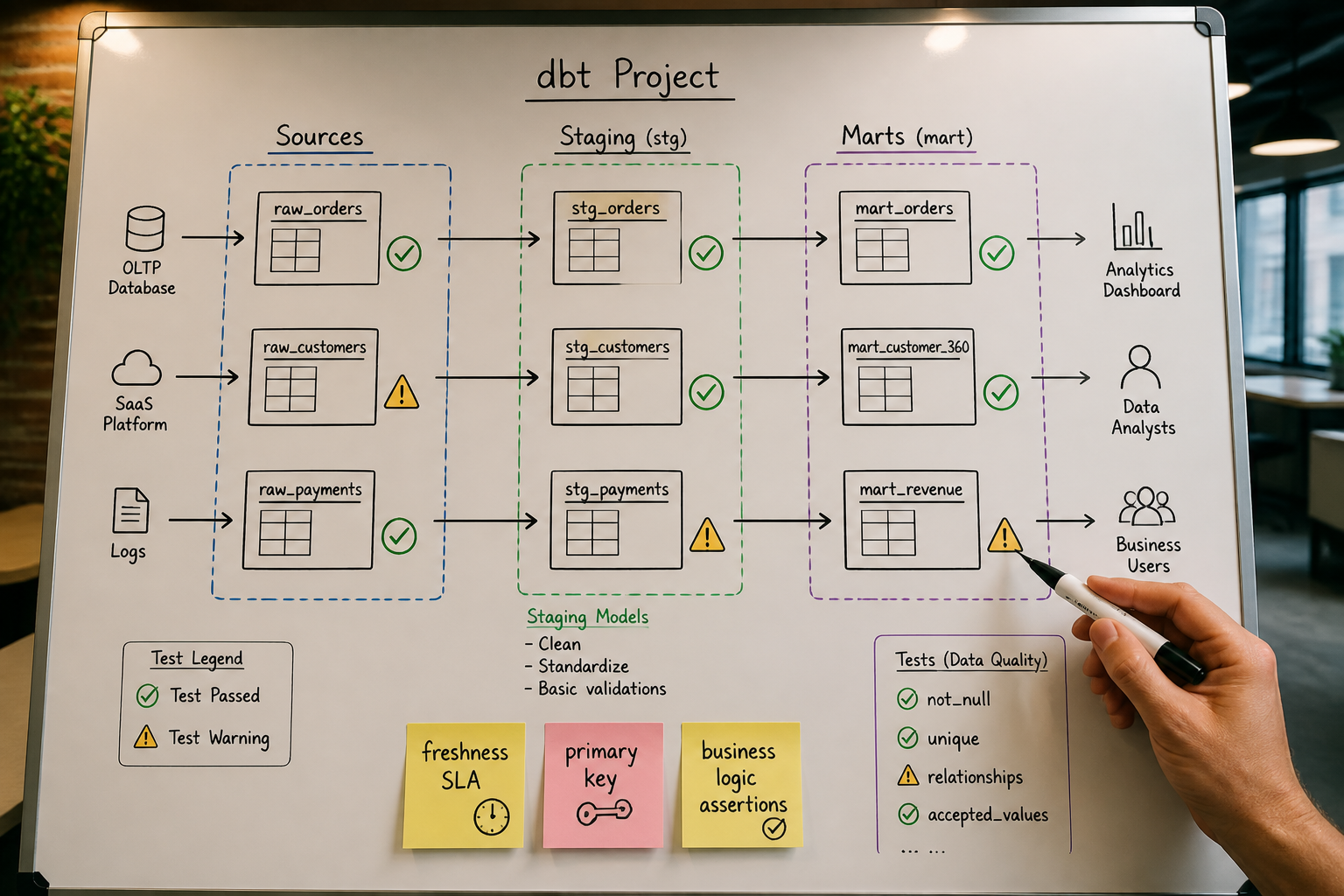
Before designing your test strategy, you need to be honest about what dbt's native testing framework gives you and where it stops.
What dbt covers natively:
- Schema tests (
not_null,unique,accepted_values,relationships) — these are declarative checks you add to yourschema.ymlfiles. They run after each model build and fail the job if the assertion breaks. - Source freshness tests —
dbt source freshnesschecks whether source tables have been updated within a defined SLA. If your payments API feed stops refreshing at 2am and nobody notices until 9am stand-up, freshness tests are your early warning system. - Custom generic tests — reusable SQL-based assertions you can parameterise and apply across many models. Useful for things like "this column should never exceed 100%" or "refund amounts should never exceed original transaction amounts."
- Singular tests — one-off SQL queries that assert a specific business logic condition. These are best for nuanced rules that cannot be expressed generically.
What dbt does not cover natively:
- Statistical drift — a column value that is technically valid but has shifted materially from its historical distribution will pass all schema tests
- Cross-model consistency — whether the
revenuefigure in your finance model matches therevenuefigure in your product model is not a dbt concern by default - Row-count anomalies — a model that returns 90% of expected rows will pass every schema test unless you explicitly write a row-count assertion
- Downstream impact assessment — dbt does not tell you which dashboards or reports are broken when a test fails
Traditional data quality tools alert you after bad data reaches production — dashboards break, reports show anomalies — and for enterprises managing large-scale data pipelines, this reactive approach can cost millions in lost productivity, missed SLAs, and downstream preprocessing. At startup scale, the currency at risk is trust, not just revenue.
Understanding these boundaries is essential because it determines which gaps you need to fill with tooling like Elementary, Soda, or Great Expectations alongside dbt — or, at minimum, with well-designed singular tests.
How to Structure a dbt Testing Strategy by Growth Stage
Not every startup needs the same testing depth on day one. The right strategy depends on your stage, team size, and how much downstream consequence a data failure actually has. Here is the framework we use when designing testing coverage for clients.
Pre-seed to Seed (1–2 data consumers, ad-hoc dashboards)
At this stage, the goal is to stop the most common failure modes: nulls in key fields, duplicates in grain-defining columns, and source freshness failures. This is your minimum viable test suite:
- Apply
not_nullanduniqueto every primary key across all staging and mart models - Apply
accepted_valuesto any status or category column that drives segmentation logic - Add
source freshnessSLAs to every raw source table that feeds a business-facing model - Write one singular test per mart model that asserts the row count is above a minimum threshold
This will catch roughly 70–80% of the data failures that actually harm startup analytics in practice. It takes less than a day to implement across a typical seed-stage dbt project and slots directly into your CI/CD pipeline.
Series A (3–8 data consumers, live dashboards, investor reporting)
By Series A, metrics have become contractual. Investors are referencing dashboard numbers in board materials. The testing strategy needs to shift from "catch obvious breaks" to "guarantee specific business logic is correct."
Additional layers to add at this stage:
- Cross-model consistency tests: Assert that the sum of
net_revenuein your finance mart matches the sum in your executive summary model within an acceptable tolerance. A 0.1% discrepancy between two models that supposedly represent the same number is a governance failure. - Referential integrity tests: Every foreign key relationship that matters to your reporting should have a
relationshipstest. If apayment_idin your transactions model doesn't resolve back to your payments source, something is wrong upstream. - Business logic singular tests: If your LTV calculation depends on a specific cohort window, write a test that asserts that window is never zero. If your MRR model excludes refunds, write a test that asserts refund-tagged transactions never appear in the output.
- dbt test severity configuration: Not all failures are equal. Use
warnseverity for anomalies you want visibility on without blocking the run; useerrorseverity for failures that should stop the pipeline entirely. Mixing these up is a common mistake — teams that set everything toerrorend up with pipelines that break on minor edge cases, so they turn testing off altogether.
If you're looking to implement a structured testing approach across your dbt project, explore how Fintel Analytics builds and governs data stacks for growth-stage businesses — we design testing frameworks that fit the stage you're actually at, not the one you'll be at in three years.
Series B (10+ data consumers, operational teams, regulatory exposure)
At Series B scale, the primary risk is not individual model failures — it's undetected drift and cross-team inconsistency. The same metric appearing differently in the finance dashboard and the product dashboard is the most confidence-destroying event a data team can produce. We have seen this scenario end the credibility of entire analytics functions.
Additional layers at Series B:
- Elementary or Soda integration: Add anomaly detection on top of dbt's native tests. These tools track historical distributions and alert you when a metric shifts beyond its normal range, even if it passes all schema tests.
- Documented test coverage metrics: Track what percentage of your mart-layer models have tests on every column. Make this visible in your data catalogue or README. Coverage below 80% at this stage is a red flag.
- Test result logging: Pipe dbt test results to a table in your warehouse so you can trend test failures over time. A model that fails its freshness test three times per week has an upstream reliability problem that needs fixing at source, not patching with retries.
The Most Common dbt Testing Mistakes We See in the Field
Having reviewed dozens of dbt projects across fintech, payments, and e-commerce clients, these are the failure patterns that appear most often:
1. Testing only the staging layer, not the marts Teams often add tests to their staging models (the first transformation layer) and assume that means their output models are validated. It doesn't. A mart model can join two clean staging models and produce incorrect results because of a fan-out join or incorrect aggregation logic. Test the output, not just the input.
2. Using not_null as a proxy for correctness
A column that is not null and not obviously wrong can still be systematically incorrect. We worked with a global payments company whose transaction count looked healthy on every schema test — but a silent deduplication failure was causing roughly 15% of transactions to be double-counted. The fix required a singular test asserting that the grain of the model was exactly one row per transaction_id at the mart level, not the staging level.
3. No test alerting infrastructure Writing tests is half the work. If a test failure at 3am doesn't wake up a Slack channel, it might as well not exist. Connect your dbt Cloud job run notifications — or your Airflow/Dagster DAG — to a dedicated data alerts Slack channel. Every test failure should be visible to the on-call person within minutes, not discovered the next morning.
4. Treating test maintenance as optional
Tests break when the business logic they encode changes. A company that redefines "active customer" in Q3 needs to update the accepted_values test on the customer_status column at the same time. Tests that are left stale either produce false positives (destroying trust in the test suite) or miss real errors because the expected values no longer reflect the actual business definition.
5. Not testing source data at all
This is the single biggest gap in early-stage dbt projects. Most of the failures we encounter originate in source data — schema changes from third-party APIs, missing records from ETL connectors, malformed JSON fields. Source tests using dbt's sources configuration (including freshness checks and column-level assertions on raw tables) are your first line of defence and the most consistently neglected.
Migrating calculations from spreadsheets into dbt models and adding a proper test suite eliminated a class of recurring manual errors for one of our e-commerce clients — and cut weekly maintenance time by 30 minutes. The tests themselves took half a day to write.
For a deeper look at how testing fits into the broader data engineering lifecycle, see our guide to DataOps for Startups.
Building the Minimum Viable Test Suite: A Step-by-Step Reference
Here is the exact sequence we follow when adding a test layer to a dbt project that has none:
Step 1 — Audit your mart models
List every model in your marts/ directory. For each one, identify: the primary key, the grain (what does one row represent?), any status or category columns, and any numeric columns that roll up into dashboards or reports. This audit takes 1–2 hours and prevents you from writing redundant or misaligned tests.
Step 2 — Add schema tests to schema.yml
For every mart model, add not_null and unique to the primary key. Add accepted_values to every status column. Add relationships to every foreign key. This is declarative — you're describing what should be true, and dbt generates the SQL.
Step 3 — Add source freshness thresholds
In your sources.yml, define freshness blocks with warn_after and error_after thresholds for each source table. A typical starting point: warn at 6 hours, error at 24 hours. Adjust based on the actual update cadence of each source.
Step 4 — Write singular tests for business-critical logic
For each mart model that feeds a KPI, write at least one singular test that asserts a non-obvious business rule. Examples: refunds should not exceed gross revenue, transaction counts should be positive, MRR should be within 20% of prior month. Store these in tests/ alongside your models.
Step 5 — Configure severity and alerting
Set primary key and freshness failures to error. Set distribution anomalies and minor business logic warnings to warn. Wire your dbt job notifications to Slack or PagerDuty. Document which failures require immediate intervention and which are informational.
Step 6 — Add tests to your CI pipeline
Run dbt test as part of your pull request CI check using dbt Cloud's CI feature or a GitHub Actions workflow. No PR that breaks an existing test should merge without deliberate sign-off. This single step, more than any other, prevents regressions.
According to the dbt Labs 2024 State of Analytics Engineering report, 41% of data teams report negative budget impacts from economic pressures — teams must deliver more with reduced resources and headcount. A robust test suite is one of the highest-leverage investments you can make precisely because it reduces the human review burden. Every hour your team spends manually cross-checking dashboards is an hour that a well-written dbt test should be doing instead.
For teams thinking about how testing integrates with model performance and monitoring, our posts on why your dbt models are running slow and ML model monitoring for startups cover the adjacent problems in detail.
Frequently Asked Questions
Q: How many dbt tests should a startup have?
A: There is no universal number, but a practical benchmark is at least one test per column in every mart-layer model, plus source freshness checks on every raw source table. A typical Series A dbt project with 20–40 mart models should have 200–400 tests. Coverage matters more than count — prioritise the columns and models that feed business-critical metrics.
Q: What is the difference between dbt schema tests and singular tests?
A: Schema tests (also called generic tests) are declarative assertions defined in schema.yml — not_null, unique, accepted_values, relationships. They apply to columns and run automatically. Singular tests are standalone SQL files in your tests/ directory that return rows when the assertion fails. Use schema tests for universal data quality rules and singular tests for business-specific logic that cannot be expressed generically.
Q: Should dbt tests run on every model build?
A: Yes, as a default. For large projects where full test runs are expensive, use test selectors to scope tests to recently modified models in CI and run the full suite on your scheduled production jobs. The key principle is that no model should reach production without its tests having passed in the same run.
Q: How do I handle dbt test failures in production without breaking dashboards?
A: Use dbt's severity configuration to distinguish between error (stop the run, do not update downstream models) and warn (log the failure, continue the run). Critical failures — null primary keys, freshness breaches beyond SLA — should be errors. Anomalies and soft business rule warnings should be warns. This prevents dashboards from going stale on minor issues while still surfacing them for investigation.
Q: What dbt testing strategy is right for a startup with no existing tests?
A: Start with the minimum viable test suite: not_null and unique on every primary key, accepted_values on status columns, and source freshness thresholds on all raw sources. Add singular tests for your top five KPIs. Wire notifications to Slack. This can be implemented in a single sprint and will catch the majority of real-world data failures before they reach stakeholders.
If your business is making decisions from dashboards built on untested dbt models, you are operating with more risk than you realise — and the failure mode is almost always a quiet one that compounds over weeks before someone notices. At Fintel Analytics, we have helped fintech, payments, and e-commerce businesses build testing frameworks that actually get maintained — from initial coverage audits through to CI integration and alerting — and the difference in stakeholder trust is immediate and measurable. If your team is ready to stop discovering data errors in board meetings, we should talk.