 Fintel Analytics
AI Trading Agent Validation: Build a Simulation That Can't Lie
Most trading simulations flatter the agent being tested. Here is how to validate an AI trading agent with real fees, live data and a ledger nobody can quietly edit.
AI trading agent validation means proving an agent can make money under the conditions it will actually trade in: live market data, real fees, real minimum order sizes, and a record of every decision that nobody can edit afterwards. A backtest alone cannot prove this, because it lets the agent, the data and the person running the test all quietly cooperate. The only simulation worth trusting is one built so it cannot flatter itself.
If you are a fintech founder or CTO building anything that moves money automatically (a trading agent, a treasury rebalancer, an FX hedging bot), you will hit this problem. The first demo looks great, the numbers are better than anyone expected, and the team is already talking about going live. That is exactly the moment to get suspicious. In our work with early-stage fintech companies, the pattern is consistent: the dangerous gap is not between the agent and the market, it is between the agent and the way it was measured.
This post sets out how we approach it: where simulations lie, what an honest paper-trading setup needs, how to make the record tamper-evident, and how to decide when an agent has earned the right to touch real capital.
Why Do AI Trading Agent Backtests Look Better Than Reality?
Because a backtest is a controlled environment, and every control is an opportunity for optimism to leak in. The agent sees data it would not have had, trades at prices it could not have got, pays fees nobody modelled, and gets tuned until the curve looks good.
A 2026 paper on evaluating LLMs in finance names five recurring biases: look-ahead bias, survivorship bias, narrative bias, objective bias, and cost bias. Three of these matter most in practice.
Look-ahead bias is worse with LLM agents. Classic look-ahead bias is a data-alignment bug, such as using a closing price to make a decision at the open. With a language model inside the loop there is a second form. A 2026 paper on agentic portfolio management notes that a workflow can contain properly backtested quantitative components while its agentic behavior remains exposed to a new, separate, LLM-specific form of look-ahead bias. In plain terms, the model may already know how the year you are testing ended.
The research on this is not flattering. A 2025 study retested two LLM-based investing agents over a longer and broader historical setup and found their risk-adjusted performance trails a passive benchmark. The authors argued that earlier positive results were overstated because of survivorship and data-snooping biases. Another 2026 benchmark, summarised by a practitioner guide, reports that when memorized market history is properly excluded, the apparent skill of LLM trading agents drops sharply.
Cost bias is the one founders forget. The same 2026 bias paper gives the example of a complex LLM trading system that is profitable in backtests but loses money once inference costs and latency are included. If your agent calls a model on every decision, the model bill is part of the strategy's cost base. A simulation that ignores it is not simulating your business.
Fill assumptions are the quiet killer. One 2026 write-up on prediction-market bots describes backtest fills at the mid-quote while live fills land on the stale side, so the live equity curve diverges sharply from the backtest. This is a practitioner blog rather than peer-reviewed research, but it matches what we see: the spread and the minimum order size eat edges that look solid on paper.
📺 Watch: I Built an AI Agent That Trades Stocks and made me Money!

What Does an Honest Paper-Trading Setup Need?
We stopped treating backtesting and paper trading as one activity. A backtest tells you whether an idea is worth testing. Paper trading tells you whether it survives contact with a live market. Only the second can support a go-live decision, and only if it is built with the following constraints.
1. Real live data, with no replay
The agent should consume the same live feed it would use in production, such as a live exchange order book, with timestamps recorded on arrival. Nothing is replayed, so the model cannot have memorised the answer and the data cannot be re-cut after the fact. For an LLM-driven agent this is the cleanest way around the memorisation problem, because every decision is made on data that did not exist when the model was trained.
2. Real fees and real minimum order sizes
In the autonomous trading agent we built, the simulator charges the actual fee schedule and respects the actual minimum order size of the venue. That sounds trivial. It is not, because it changes which strategies are viable at all. Small-account strategies that look elegant at fractional sizes often fail the first time the venue rejects an order for being too small. Fees on a high-turnover strategy can erase the entire edge. If the simulator is generous on either, the agent will be too.
3. Fills priced against the book, not the mid
A paper trade should be priced as if it had crossed the spread against the visible order book at the moment of the decision. Optimistic fills are the easiest way for a simulation to flatter itself, and the cheapest to remove.
4. Every model call costed
Every paid model call is logged with its cost and attached to the decision it informed. This is the same discipline we apply to every agent we ship, and it connects directly to the problem we describe in our post on why AI agent runs fail and how to fix them: if you cannot say what a run costs and what happens when it is wrong, you do not have a production system, you have a demo.
5. Reproducibility you do not assume
Do not assume a re-run gives the same answer. The 2026 agentic portfolio paper points out that even at temperature zero, floating-point arithmetic, batching, and inference hardware can cause nominally identical LLM calls to produce different outputs. That is why the record of what the agent actually decided matters more than the ability to re-run it.

How Do You Make a Trading Simulation Tamper-Evident?
The most common way a simulation flatters itself is not a bug. It is a person. Someone fixes a bad trade record, deletes a failed run, restarts the test after a rough week, or adjusts a threshold mid-stream. Each edit feels reasonable. Together they turn a test into a story.
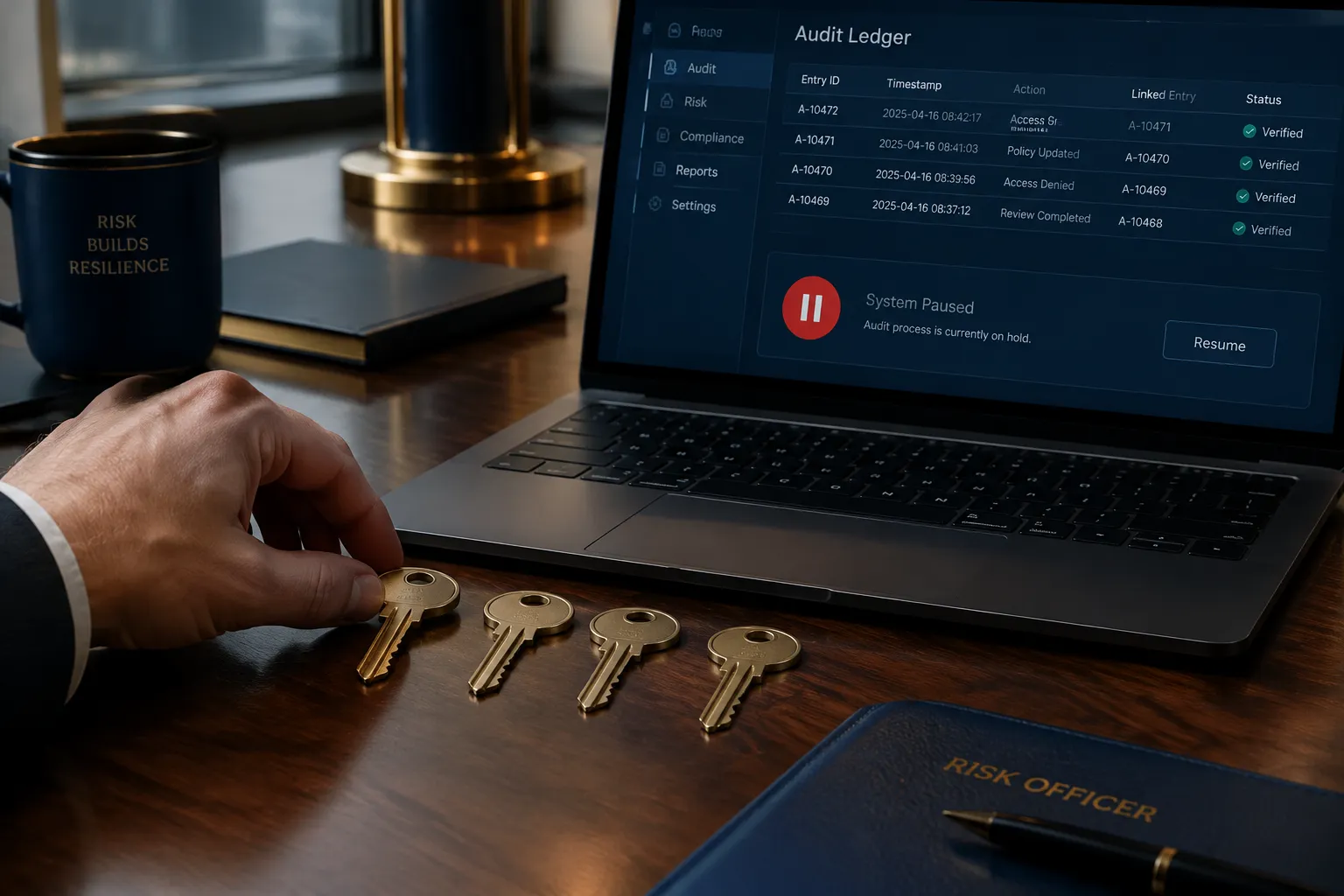
The fix is to make history impossible to change quietly. We write every trade, and every decision behind it, to an append-only ledger in which each entry includes a hash of the entry before it. This is the same principle that makes a blockchain tamper-evident, without needing a blockchain.
The mechanics are simple:
Entry 1: trade details + hash of nothing (genesis) = hash A Entry 2: trade details + hash A = hash B Entry 3: trade details + hash B = hash C
If anyone edits Entry 2 after the fact, its hash changes, which breaks Entry 3, and every entry after it. A verification job that re-walks the chain flags the break instantly. You cannot delete a losing trade without it showing.
This gives you three things a spreadsheet of results never will:
- A defensible record. When an investor, auditor or regulator asks how the agent performed, the answer is a verifiable chain, not a screenshot.
- Honest performance numbers. Losses stay in. The track record is the whole record.
- Debuggable decisions. Each entry stores the inputs the agent saw, the action it took and the cost of the model calls behind it, so a bad trade can be traced to a cause.
A pattern we see repeatedly is critical records living in a spreadsheet that anyone can edit. When the numbers are later questioned, nobody can prove what the sheet looked like last month. The same weakness shows up in finance operations, where we have seen a reconciliation project uncover a $25M discrepancy that had gone undetected, which at market borrowing rates was costing over $6,000 per day. A record that cannot be quietly changed is as valuable in operations as it is in trading.
If you're looking to build this kind of tamper-evident, audit-ready automation in your organisation, explore how Fintel Analytics approaches this. We work with businesses globally to design and deliver production-grade agents with cost tracking, approval steps and audit trails built in from day one.
When Should an AI Trading Agent Be Allowed to Go Live?
Most teams answer this with a feeling: the curve looks good, the founder is confident, and someone flips a flag. We think that is the wrong shape of decision. Going live should be hard, deliberate and slightly annoying.
In the trading agent we built, execution can only move from simulation to live after two conditions are met. First, the paper-trading ledger has to show the agent hit a pre-agreed performance target. Second, four separate locks have to be released by hand. No single person, setting or deployment can switch it on alone.
The exact locks depend on the client, but they fall into recognisable categories:
- A performance gate checked against the verified ledger, not a manually reported figure.
- A risk-limit sign-off, where a named human approves position sizes, loss limits and the maximum capital at risk.
- A permissions lock, where live execution credentials are not available to the agent until someone deliberately provisions them.
- A kill-switch check, confirming that the pause mechanism has been tested and works before it is needed.
The design principle matters more than the specific list: the agent must not be able to talk its way into live trading, and neither must an enthusiastic team member. This is the same logic as the human-in-the-loop controls we describe in our guide to the AI agent approval workflow and audit trails, applied to the highest-stakes action an agent can take.
A decision framework you can use
Before any agent that moves money touches real capital, ask five questions:
- Has it run on live data, with real fees and minimum sizes, for long enough to see more than one market regime? Four weeks is a floor, not a target. One practitioner guide suggests 2-4 weeks of live-data paper trading as a bridge from backtest to live, which we read as the minimum.
- Is the record tamper-evident? If someone could have edited it, assume someone did.
- Does performance survive the full cost base? That includes fees, spread, slippage and model costs.
- Does a number you set in advance define success? If the target moved after you saw results, it is not a target.
- Can a human stop it in seconds, and has that been tested? A kill switch that has never been used is a hope, not a control.
If any answer is no, the agent is not ready, regardless of how good the equity curve looks.
How Much Does Proper AI Agent Validation Cost?
Less than founders expect, and far less than one bad live deployment. The cost structure has three parts: engineering the simulator and ledger, running the paper-trading period, and the model spend during that period.
The model spend is where discipline pays off most. In a go-to-market agent we built for a pre-seed company, the cost per outreach-ready lead fell from $1.28 to $0.05 once we fixed the prospecting stage and put every model call under cost tracking. In the same system, failing runs dropped from 86% to 14%. The lesson carries straight over to trading agents: route routine work to cheap models, reserve the expensive model for decisions that justify it, and show every call in a cost log. We cover the routing side in more depth in our post on LLM model routing strategy.
Two cost mistakes to avoid:
- Treating validation as overhead. The simulator is the product. Without it you have no evidence, only an opinion about your own agent.
- Skipping the kill switch because it is boring. In the go-to-market system, a kill switch that pauses the whole pipeline was built in from the start. It costs almost nothing to build and it is the control you will be most glad of at 3am.
This is also where the typical failure mode of AI projects shows up. A pattern we see repeatedly is AI pilots that never reach production because nobody can say what they cost per run, what happens when they are wrong, or who approves their output. Validation infrastructure answers all three questions before anyone has to ask.
What Should You Build First?
If you are starting from a promising prototype, resist the urge to improve the agent. Build the measurement first.
- The ledger. Append-only, hash-chained, with every decision, input and cost recorded.
- The honest simulator. Live data, real fees, real minimum sizes, fills priced against the book.
- The cost log. Every paid model call visible and attributed.
- The kill switch and the locks. Built and tested before any live credentials exist.
- A dashboard for the people who decide. Performance, costs, drawdown and ledger integrity in one place, so the go-live conversation is held on evidence. We typically build this on a warehouse and semantic layer so that finance and engineering are looking at the same numbers.
Only then start tuning the agent. Every improvement becomes measurable, and the evidence is trustworthy because it was collected by a system the builders could not influence.
Frequently Asked Questions
Q: What is the difference between backtesting and paper trading an AI agent?
A: A backtest replays historical data to test whether an idea has merit, and it is vulnerable to overfitting, look-ahead bias and optimistic fills. Paper trading runs the agent on live market data in real time with simulated money, so it cannot have seen the data in advance. Paper trading with real fees and order sizes is the stronger evidence for a go-live decision.
Q: Why do LLM trading agents look better in backtests than in live trading?
A: The model's training data may include the very period being tested, so it can recall prices and outcomes rather than predict them. Research from 2025 and 2026 also points to survivorship bias, data snooping and ignored inference costs as inflating results. Testing on live data that did not exist at training time removes the memorisation problem.
Q: How long should you paper trade an AI trading agent before going live?
A: There is no universal number, but a few weeks of live-data paper trading is the minimum, and you want enough trades and more than one market condition to judge it. Set the performance target before you start, and treat it as fixed. Longer is better when the agent's strategy trades infrequently.
Q: What is a hash-chained ledger and why use one for trading?
A: It is an append-only record where each entry contains a cryptographic hash of the previous entry. If any past trade is edited or deleted, every later hash breaks and verification fails. It makes your track record tamper-evident without needing a blockchain.
Q: How do you stop an AI trading agent from going live by accident?
A: Require multiple independent controls that humans release by hand, such as a verified performance gate, a risk-limit sign-off, a permissions lock and a tested kill switch. No single flag or person should be able to enable live execution. The agent should never hold live credentials until every lock is released.
Build Validation Before You Build Confidence
The challenge most fintech teams face with AI trading agent validation is not building a smarter agent, it is building a measurement system honest enough that the agent's results can be believed by investors, auditors and the team itself. At Fintel Analytics, we have built exactly this: simulations that paper-trade against live data with real costs, ledgers that cannot be quietly rewritten, and staged go-live controls that keep a human in charge, alongside the data foundations and dashboards that support them. If you have a promising agent and no reliable way to prove what it does, that is a fixable problem, and fixing it before real capital is at risk is the cheapest decision you will make this year.